
EMERGENT TECHNOLOGY WORK GROUP - ED TECH REVIEWS
Rumi for AI Literacy
by Beth Hale
Learning Technologies Facilitator
Chemeketa Community College
Feb 19th, 2025
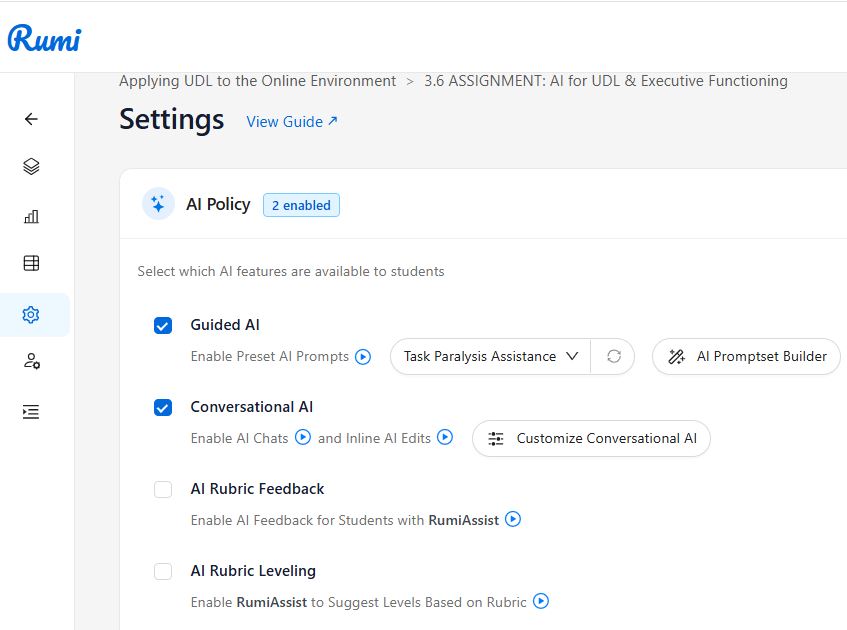
Screenshot of Rumi settings with “Guided AI” and “Conversational AI” options enabled.
Project Overview
The pilot opportunity was open to all Chemeketa faculty, and offered a stipend for participation in pilot activities like training, use with students, and evaluation.
The pilot license spanned three terms to allow for implementation, support and use with students.
- Spring 25 – Staff training on Rumi, Canvas testing, and promotion to faculty
- Summer 25 – Faculty training, testing and assignment development
- Fall 25- Canvas implementation with student-use of Rumi
Feature promotion and training was provided around these unique aspects of Rumi:
- Transparent student access to ChatGPT, Claude and/or Gemini from within Canvas assignments
- Guided AI use- Instructors can limit available prompts or customize prompts
- Trainable – Instructors can provide Rumi with context & custom content
- Rubric feature- Options for AI-generated rubrics, AI-feedback provided to students, and AI grading feedback based on the rubric
Results
Sixteen instructors participated in the pilot testing and training, with seven implementing Rumi in ten of their fall courses with students. A total of 1,196 essays were submitted by 275 unique student-users. In terms of AI-policy, 17% of assignments allowed no AI, while the remaining allowed some or open AI use. The most frequently-used AI prompts show that the majority of student AI use was for basic writing support, like grammar and spelling. A number of students used language translation feature, which revealed an unanticipated need.
We are also planning on setting up one unit at the LCC Childcare Center. This facility is secure and has outdoor plugs so we can set it up as a permanent listening station at the college using the power cord.
Top 10 AI Prompts
| Prompt | Count |
| Fix Grammar And Spelling | 568 |
| Enhance Clarity And Conciseness | 246 |
| Improve Sentence Structure | 196 |
| Elaborate More | 114 |
| Translate To English | 48 |
| Give Feedback On Content | 46 |
| Give Feedback On Writing | 28 |
| Improve Vocabulary | 21 |
| Provide Feedback | 10 |
| Fix Spelling | 5 |
Pilot student and instructor feedback on Rumi had mixed reviews. Students in several courses reported that the Rumi interface was confusing or an unneeded distraction, while students in other courses found Rumi beneficial.
RUMI was used for two assignments with my Technical Writing Students. I allowed AI use, and appreciated the assignment being visible on the screen for them and the rubric, and they said they appreciated the RUMI help, and the clear guidelines on AI allowance and citation–acknowledgement. ~Writing Instructor Feedback
Most instructors found Rumi easy to use, but felt that limited training and preparation time was a barrier to use. When asked for their overall impression on the value of a Rumi license, and all pilot instructors felt that Rumi did not add enough value for the cost.
Lessons Learned
While the Rumi features worked very well for some, overall faculty adoption was low. The relatively low-interest and persistence with Rumi reflects these challenges with implementing Rumi at this time:
- Rumi only works within Canvas Assignments, and much student writing is happening in Canvas Discussions or MSWord.
- Rumi’s AI detection functionality is not as reliable as other products, like GPTZero or Pangram. AI detection is a commonly-cited need from Chemeketa’s faculty.
- The pilot timing is too early in AI literacy work. Rumi’s true potential and value lies with its focus on AI literacy, and features like the ability to customize prompts and content, or to provide AI-feedback based on a rubric. The majority of our faculty are not yet to this stage of AI use with students.
- Not enough time in the pilot. Although many faculty are exploring how to allow/encourage students to use AI ethically and productively, and how to have students reflect their AI use, that work takes considerable curriculum development time.
These challenges, along with pilot faculty feedback, lead the CAI to recommend that Rumi is a tool ahead of its time for broad use at Chemeketa, although it may currently have a place with a small group of early-adopters.
Next Steps
At the end of the pilot, Rumi extended a reasonable offer that allowed Chemeketa to continue with the license through June, 2026. Rumi’s Canvas integration and license agreement with Chemeketa makes it a safe space for experimentation with customized and guided AI literacy assignments. We continue to promote its use as we work with faculty on incorporating AI skills and literacy into their instruction.


TECHNOLOGY EXPLORATION
Do you have an emergent technology you would like to explore? Submit your nomination for a technology evaluation by the OCCDLA Emergent Technology Workgroup.
The OCCDLA Emergent Tech Work Group receives nominations for instructional technology review from work group members and our nomination form, available to all instructors and administrative staff of all Oregon Community Colleges.
Questions?
For questions about the Emergent Technology Work Group:
Administrative Contact:
Monica Marlo
Portland Community College
monica.martinezgallagher@pcc.edu